A year ago, I moved to Barcelona to begin the InnoEnergy Masters+ in Renewable Energy at Universitat Politècnica de Catalunya (UPC). Now, as I start my second year at KTH Royal Institute of Technology in Stockholm, I realise how much can change in twelve months when I look back on that first year.
I am originally from Spain, where I studied Physics at the University of Salamanca. During my degree, I became increasingly drawn to how science could be applied to some of the challenges that will define the coming decades. Energy stood out because it sits at the intersection of so many of them: climate change, technology, economics, and the way our societies develop.
When I started looking for a Master’s, I knew I wanted to move closer to the renewable energy sector, but I did not want my education to stop at the technical side. What attracted me to InnoEnergy Masters+ was the combination of things that would have been difficult to find in a conventional programme: studying at two European universities, learning alongside people from all over the world, working directly with industry, and complementing the technical curriculum with business and entrepreneurship at Esade Business School.
My First year in UPC
My first year at UPC gave me the technical foundation I was looking for, but it also changed the way I understood the energy transition.
Two courses that stayed with me were Renewable Energy Technologies and Energy Planning. The first gave me the chance to explore a wide range of technologies — from wind and solar to hydrogen, bioenergy, and other energy conversion systems. Coming from Physics, I enjoyed understanding the principles behind each technology while also seeing how they combine and function in real energy systems.
Energy Planning gave me a different perspective. Rather than looking at one technology in isolation, it pushed me to think about the energy system as a whole: demand, resources, economics, markets, and the decisions that determine how energy infrastructure is actually built.
That broader perspective became one of the most important lessons of the year. A technology can be technically impressive, but the energy transition does not happen in a laboratory. Technologies have to work within economic, industrial, and social realities.
Working on a Real Industry Challenge — Kerionics
During the second semester, some of my classmates and I worked with Kerionics as part of our Renewable Energy Project course. This was the experience that changed how I think about problem-solving in the energy sector.
Kerionics develops high-temperature solid oxide electrolysis technology for green hydrogen production, particularly for energy-intensive industries. Our challenge was to explore how the company could approach its first commercial deployment in Africa.
We eventually focused on the Ethiopian cement sector and developed a proposal for the deployment of a 1 MW solid oxide electrolysis system. This meant going far beyond analysing whether the technology itself could work. We had to understand the market, identify potential industrial users, consider financing mechanisms, assess risks, and think about what kind of commercial structure could make a first deployment realistic.
The most valuable part of the experience was learning what happens when a problem no longer has a predefined answer.
At university, we are usually given problems with clearly defined boundaries and most of the information we need already provided. Working on a real industry challenge was different. Information was incomplete, assumptions had to be questioned, and the technical side was only one part of the decision.
It made me realise that solving problems in the energy sector often means making good decisions under uncertainty — balancing technology, economics, and what is actually feasible for a company at a given moment. That is a skill no course can fully teach. You have to live it.
If you want to read more about what a real industry project and thesis experience can look like at InnoEnergy Masters+, Hsiang-Yu Hung wrote about his journey into battery storage and energy markets here, and Margot shared what her thesis experience in Ghana looked like here.
A Different Perspective at Esade
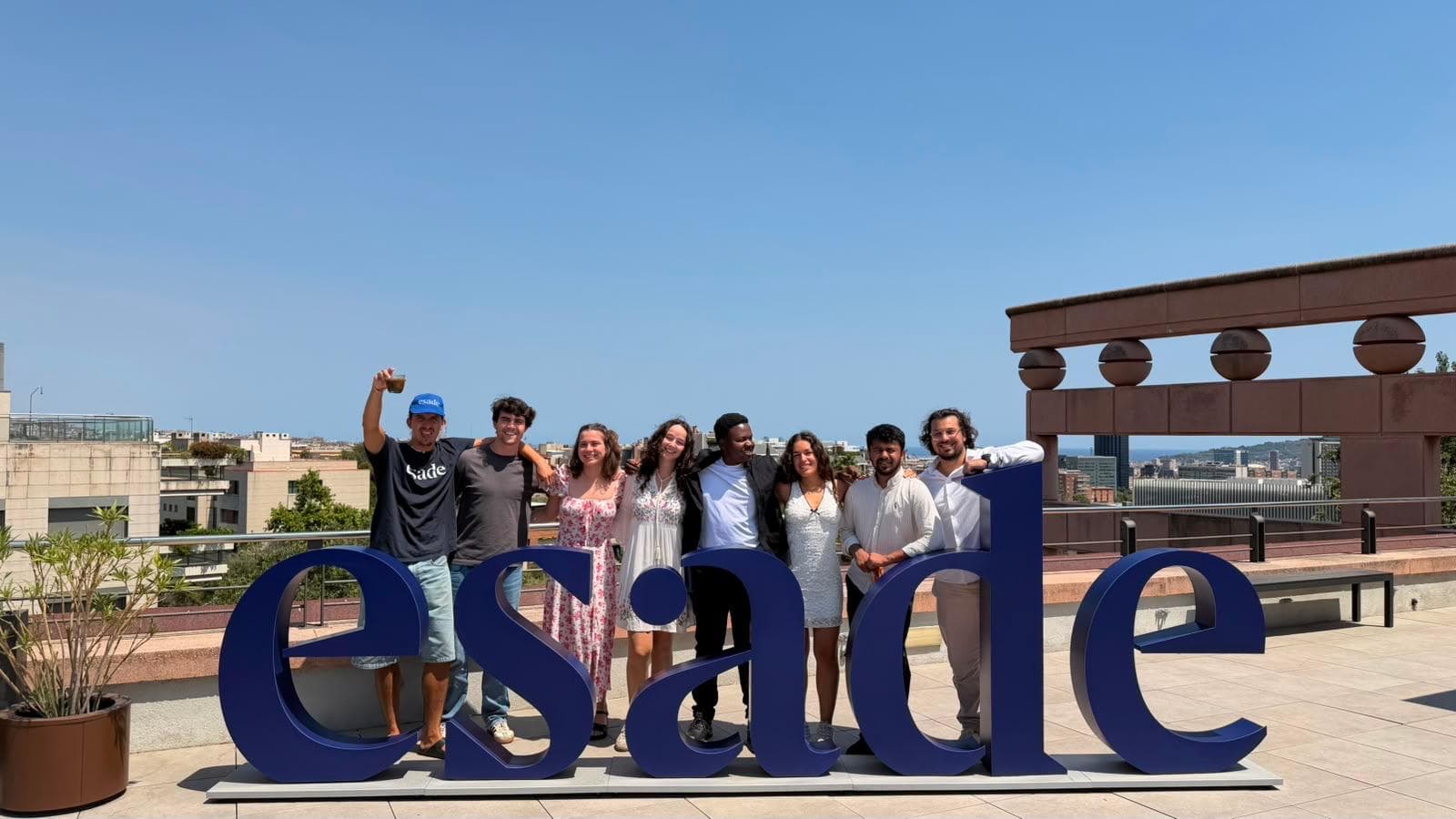
Another part of the programme that genuinely took me outside my comfort zone was the Management and Entrepreneurship track at ESADE Business School.
Coming from Physics and spending most of my academic life thinking in technical terms, entering a business school environment was a completely different way of learning. Throughout the year, we explored entrepreneurship, innovation, strategy, and finance — but the biggest shift for me came through our New Venture Creation Project.
Together with my team, we developed AquaNova, a climate-tech concept combining ocean-based carbon dioxide removal with green hydrogen production. We had to take the idea beyond its technical foundations and think about it as if we were actually trying to build a company.
One of the biggest mindset shifts of the year was moving from asking only “Can this technically work?” to also asking “Does this solve a real problem, and can it become something viable?” That distinction sounds simple. But it changed the way I look at innovation.
More Than Just a Classroom
Despite everything I learned academically, if there is one thing I will remember most from my first year, it will be the people.
Our class brought together students from many different countries, cultures, and academic backgrounds. At first, those differences meant different ways of communicating and working in teams. Over time, they became one of the things I valued most.
The activities organised through CommUnity+ were also an important part of the experience — opportunities to step away from assignments and spend time together as people, not just classmates. Many of my favourite memories from the year came from those moments.
Somewhere along the way, Barcelona stopped feeling like simply the city where I was doing my Master’s. It started feeling like home.
A New Chapter in Stockholm
For my second year, I chose KTH Royal Institute of Technology in Stockholm.
After spending my first year in Spain, I wanted the second part of the programme to take me somewhere genuinely different. Moving to Sweden meant experiencing another culture, another university system, and another way of approaching the energy transition.
There is something both exciting and challenging about arriving somewhere new and rebuilding your routine from zero. But after my first year, I have also learned that some of the most valuable opportunities begin exactly like that.
What I Would Tell Someone Considering This Programme
If someone were thinking about applying to InnoEnergy Masters+, I would tell them that the part that is hardest to understand from the outside is that the programme is not only what appears on the curriculum.
The universities, courses, and projects matter, of course. But so do the conversations after class, the industry connections, the entrepreneurship experience, the community, the people you meet, and the opportunities that appear because you decided to say yes to something. To understand more about what Careers+ and CommUnity+ actually look like in practice, read more here and here.
A year ago, I thought I was starting a Master’s in Renewable Energy. Looking back now, it feels much bigger than that.
Written by Rebeca Lobo Gago, InnoEnergy Masters+ student in Renewable Energy, currently in Year 2 at KTH Royal Institute of Technology, Stockholm.