Become the engineer who makes low-carbon power possible
Nuclear energy provides large-scale, low-carbon electricity to the power system and brings together some of the most demanding challenges in engineering: how reactors are designed and operated, how safety is managed, how fuels and materials behave over decades, and what happens at the end of a facility’s life.
The European Master’s in Nuclear Energy prepares you to work across that landscape. You begin with a broad foundation in nuclear engineering, covering reactor physics, thermal-hydraulics, safety, radiation protection, fuel cycles and plant technology. In Year 2, you choose where to go deeper: reactor physics, plant design, operations, fuel cycle, nuclear materials, or decommissioning and waste management.
Your study plan
Choose one of two universities for your nuclear engineering foundation:
-
KTH Royal Institute of Technology
- Stockholm, Sweden
- Study areas include reactor physics, thermal-hydraulics, reactor technology, nuclear safety, radiation protection, nuclear fuels and advanced reactor technologies.
-
UPC · Universitat Politècnica de Catalunya · BarcelonaTech
- Barcelona, Spain
- Study areas include nuclear engineering fundamentals, reactor physics and thermal-hydraulics, fuel cycle, safety, plant management, instrumentation and computational methods.
Move to France and choose one of six specialisation pathways:
-
Grenoble INP – UGA
- Grenoble, France
- Materials for Nuclear Energy: explore nuclear fuels, materials in nuclear environments, reactor materials and the challenges created by ageing and new reactor technologies.
*In a small number of cases, eligibility rules may require Year 1 at Grenoble INP – UGA and Year 2 at KTH Royal Institute of Technology. The Programme Coordination team contacts affected candidates directly.
- On the Paris route, you complete a common nuclear engineering core and continue into one of five tracks:
-
-
Université Paris-Saclay
- Supported by INSTN
- Nuclear Reactor Physics and Engineering: explore reactor physics, neutronics and thermal-hydraulics, with a focus on simulation, multiphysics and uncertainty analysis to understand and predict reactor behaviour.
-
-
-
ENSTA
- Supported by Institut Polytechnique de Paris
- Nuclear Plant Design: explore how nuclear plants are designed, from risk and thermal-hydraulic analysis to materials, seismic engineering, systems and equipment, and numerical design methods.
-
-
-
Université Paris-Saclay
- Supported by CentraleSupélec
- Operations: explore nuclear plant operations through operation management, control and simulation, maintenance, safety, production and non-destructive testing.
-
-
-
Université Paris Sciences et Lettres (PSL)
- Supported by Chimie ParisTech
- Fuel Cycle: explore the nuclear fuel cycle from mine to reactor, including separation and recycling, molten-salt technologies, actinide chemistry, process control, waste containment and radioactive waste management.
-
-
-
École des Ponts ParisTech
- Supported by CentraleSupélec
- Decommissioning and Waste Management: explore the engineering and management of nuclear decommissioning, from dismantling facilities and modelling decommissioning processes to strategy, waste treatment and long-term waste management.
-
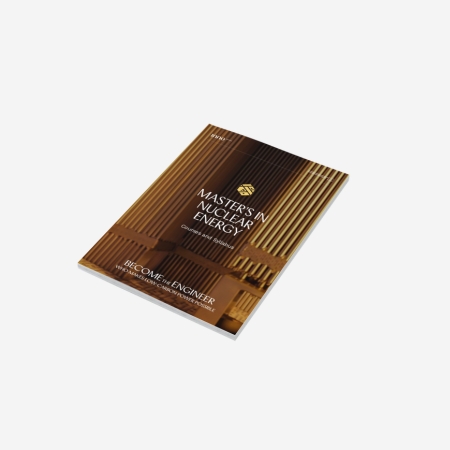
Explore the full curriculum in-depth
See exactly how the European Master’s in Nuclear Energy is structured before you choose your study path. Inside are the individual courses and ECTS, mandatory and elective requirements, the Paris common curriculum, every Year 2 specialisation, the Master’s thesis structure and the additional academic activities that sit around your degree.
Built across 7 universities and a business school
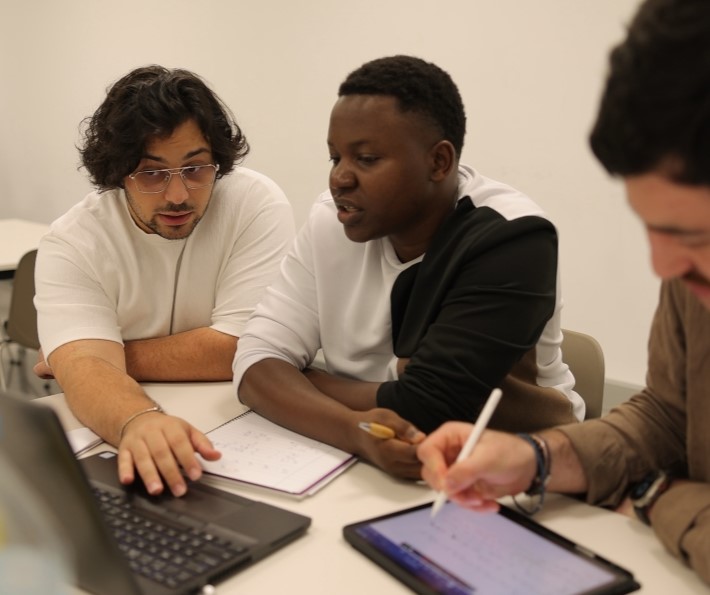
See the programme from the inside
Your thesis
Your Master’s thesis gives you five months to focus on a nuclear research or technology question and bring together what you have learned across the programme.
You complete the thesis with an industrial or research partner, working alongside specialists who can support your research and connect it to active work in the nuclear sector.
- 5 months of full-time thesis work
- 30 ECTS dedicated to your thesis
- Work with an industrial or research partner and carry out your thesis in an active engineering environment
Your degrees
After successfully completing the two-year programme, you will receive a degree from each university in your study path:
- Master of Science in Energy Innovation (TIETM) from KTH Royal Institute of Technology
- Master in Nuclear Engineering from Universitat Politècnica de Catalunya (UPC)
- Master Materials of Science: Materials Science for Nuclear Energy from Grenoble INP – UGA
- Degree corresponding to your Year 2 university and specialisation from a Paris-pathway university
Additional credentials
- Esade Business School: Certificate of Academic Participation in the Innovation & New Venture Creation Programme
- An EIT Label Certificate (from the European Union)*: additional recognition of the programme’s entrepreneurship, mobility and learning model.
- Optional digital learning: additional certificates are available for students completing eligible optional courses.
*The EIT Label is a quality seal awarded by the European Institute of Innovation and Technology (EIT) to a KIC educational programme that has been assessed positively by the EIT on the implementation of the EIT Quality Assurance and Learning Enhancement (EIT QALE) system and the application of specific quality criteria with focus on the EIT Overarching Learning Outcomes (EIT OLOs), robust entrepreneurship education, highly integrated, innovative ‘learning-by-doing’ curricula, international mobility and outreach.
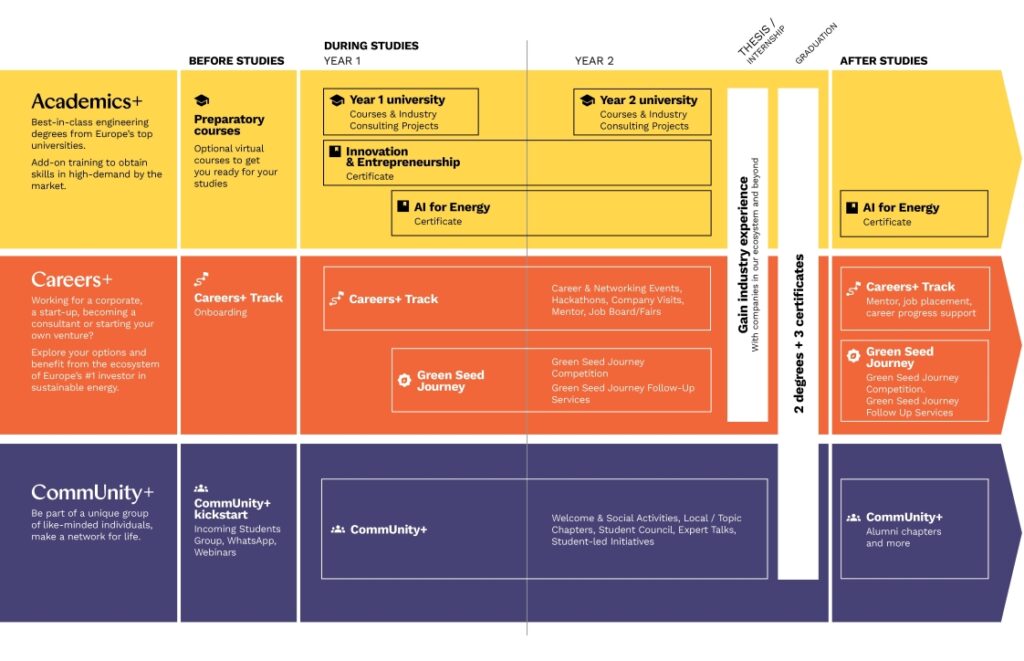
See how your whole Masters+ journey comes together
From your first steps before arrival to graduation and beyond, see how Masters+ develops across two years of academics, entrepreneurship, career development and community, and continues beyond graduation.
Where the European Master’s in Nuclear Energy takes you
Example roles:
- Reactor Engineer
- Reactor Physicist
- Neutronics Engineer
- Thermal-Hydraulics Engineer
- Nuclear Simulation Engineer
Work on how reactors behave, from neutron transport and heat transfer to modelling, simulation and performance analysis.
Example roles:
- Nuclear Systems Engineer
- Nuclear Safety Engineer
- Operations Engineer
- Maintenance Engineer
- Reliability Engineer
Work on the systems that keep nuclear facilities operating safely and reliably, including plant performance, maintenance, safety analysis and technical operations.
Example roles:
- Nuclear Fuel Engineer
- Nuclear Materials Engineer
- Materials Research Engineer
- Fuel Cycle Engineer
- Radiation Protection Engineer
Focus on how fuels and materials perform under nuclear conditions, how they change over time and how those properties affect reactor safety and performance.
Example roles:
- Advanced Reactor Engineer
- SMR Engineer
- Nuclear R&D Engineer
- Research Engineer
- Nuclear Technology Engineer
Work on emerging reactor concepts, new nuclear technologies and the engineering challenges involved in bringing them from research towards deployment.
Example roles:
- Decommissioning Engineer
- Nuclear Waste Engineer
- Dismantling Engineer
- Radioactive Waste Specialist
- Decommissioning Project Engineer
Work on the technical, environmental and operational challenges involved in taking nuclear facilities out of service and managing radioactive materials.
Example roles:
- Nuclear Project Engineer
- Technical Consultant
- Nuclear Energy Consultant
- Project Manager
- Technical Analyst
Apply nuclear engineering knowledge across projects, advisory work and multidisciplinary teams where technical decisions need to connect with economics, regulation, delivery and the wider energy system.
Companies hiring Masters+ nuclear graduates





CommUnity+
The European Master’s in Nuclear Energy takes you across universities, countries and specialisations, but you are part of Masters+ throughout the whole experience. You meet students beyond your own university and programme, build connections across the wider energy sector and join a community that continues after graduation.
CommUnity+ is where that wider Masters+ network comes together.
Talk to a student
Want to know what moving between universities is really like, how students choose their Year 2 nuclear pathway or what the workload feels like?
Admission requirements
To apply for InnoEnergy Masters+, you need:
- A completed Bachelor’s degree worth at least 180 ECTS, or equivalent
- The required level of English language proficiency
- A Bachelor’s degree that meets the programme-specific academic requirements
Still finishing your Bachelor’s?
You can apply while you are in the final year of your undergraduate degree. If your application is successful, you may receive a conditional offer while you complete your studies.
For the European Master’s in Nuclear Energy, your Bachelor’s degree should be in one of the following areas:
- Physics
- Mechanical Engineering
- Nuclear Engineering
- Chemical Engineering
- Electrical Engineering
- Energy Engineering
Have a different academic background? You may still be considered if your previous studies provide a sufficient foundation in:
- Mathematics
- Physics
- Mechanics
Applications from other academic backgrounds are assessed individually by the European Master’s in Nuclear Energy programme directors.
European Master’s in Nuclear Energy applicants must also submit a separate motivation letter explaining their reasons for applying to the programme.
The full requirements page explains the application process, required documents and the evidence you need to provide.
Looking at a different part of the energy system? Explore other Masters+ programmes
Master’s in Advanced Energy Systems and AI
Become the engineer who closes the gap between AI and energy
Master’s in Renewable Energy
Become the engineer who makes renewables scale
Master’s in Smart Electrical Networks and Systems
Become the engineer who powers electrification
Master’s in Sustainable Energy Systems
Become the engineer who connects clean tech and energy systems